
Summary
The Enhanced Credit Limit is a recommended credit exposure amount available as part of Financial Trade Data (FTD). It incorporates both financial and non-financial payment information to provide additional insight when evaluating how much credit should be outstanding with a business at any one time. [
What is an Enhanced Credit Limit?
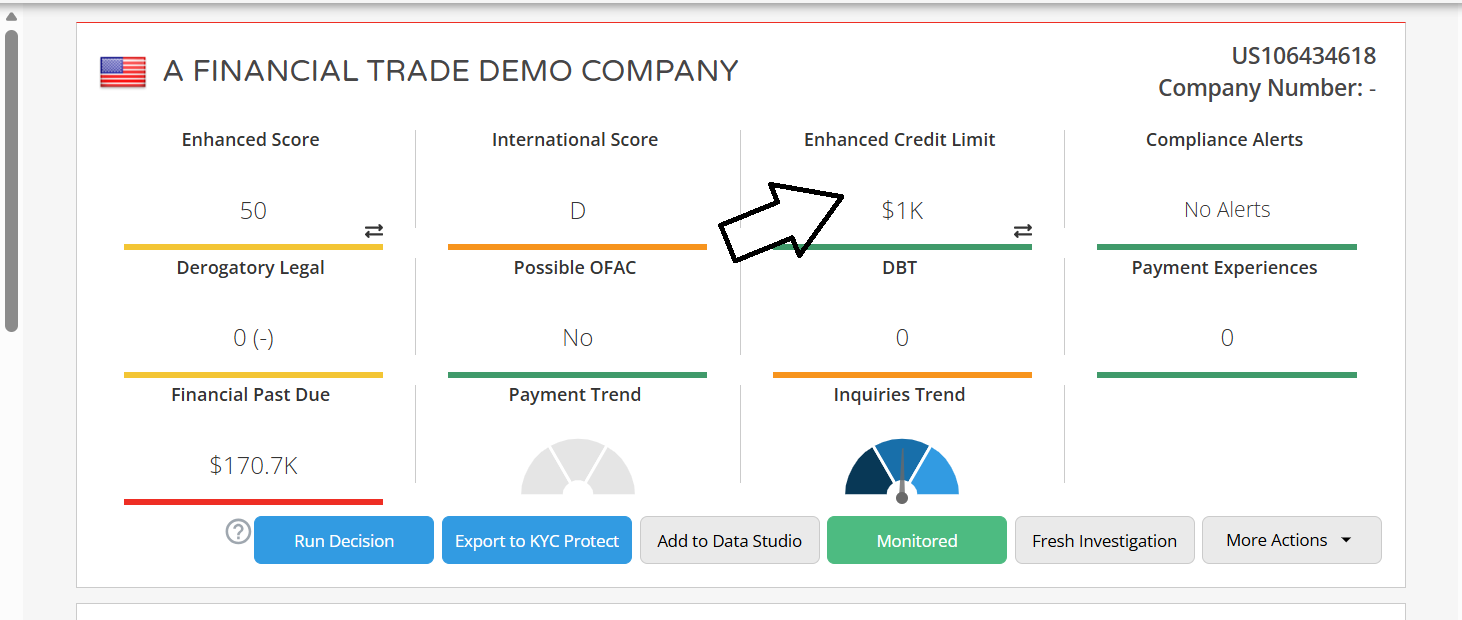
The Enhanced Credit Limit is a feature of Creditsafe's Financial Trade Data (FTD) offering. FTD adds financial payment information from sources such as banks, credit card companies and credit unions to the information available in a Creditsafe report. When Financial Trade Data is available on a company, it can provide an Enhanced Score, Enhanced Credit Limit and additional financial trade insight.
The Enhanced Credit Limit represents Creditsafe's recommendation for the total amount of credit that should be outstanding with a company at any one time.
Unlike the standard Creditsafe Credit Limit, the Enhanced Credit Limit considers both financial and non-financial payment\information, along with the payment records of similar companies.
How is the Enhanced Credit Limit calculated?
Creditsafe's Enhanced Credit Limit calculation uses several pieces of information:
- The original Creditsafe Score
- The final Enhanced Score
- The existing Creditsafe Credit Limit
- Total balances reported across financial accounts
- Available credit
- Total past-due balances
The Enhanced Score itself considers the standard Creditsafe Score, the Enhanced Score supplied through the financial trade data, and past-due balances on open and closed financial accounts. The calculation considers whether all, none, or some of the financial accounts carry past-due balances when determining the final Enhanced Score.
Once the final Enhanced Score has been established, the limit calculation considers the relationship between that score and the standard Creditsafe Score. It also evaluates the proportion of financial balances that are past due and the amount of available credit reported.
This means the Enhanced Credit Limit is designed to provide a broader view of potential credit exposure than a limit based solely on non-financial payment information.
What information can affect the Enhanced Credit Limit?
Financial Trade Data can introduce information from financial account types including:
- Business leases
- Commercial cards
- Letters of credit
- Lines of credit
- Open-ended lines of credit
- Term loans
The FTD section also provides visibility into credit utilization, helping you understand the credit a business is using compared with credit available on its financial accounts.
Past-due financial obligations are also important. Creditsafe defines Financial Past Due as the total delinquent dollars, excluding charged-off amounts, across open and closed financial accounts.
How can I use the Enhanced Credit Limit?
The Enhanced Credit Limit can be used as an additional reference point when evaluating how much credit exposure your organization is comfortable carrying with a business.
For example, a standard Creditsafe assessment may look different once financial payment data is incorporated. This is why you may see a standard Credit Limit and an Enhanced Credit Limit that do not match. The Enhanced calculation uses additional financial payment information when that data is available.
When reviewing the Enhanced Credit Limit, it can also be helpful to consider the other information available within FTD, including:
- Enhanced Score: A 1–100 score that considers financial and non-financial trade information and reflects the likelihood of serious delinquency or business failure within the next 12 months.
- Financial Past Due: Delinquent dollars, excluding charged-off balances, reported across open and closed financial accounts.
- Credit Utilization: Insight into credit used and available on the company's financial accounts.
- Financial account information: FTD can include account information for products such as commercial cards, leases, lines of credit and term loans.
Looking at these elements together can provide additional context for evaluating a business's payment behavior and credit exposure.
Why can the Enhanced Credit Limit differ from the standard Credit Limit?
The two limits do not use exactly the same information.
The standard Creditsafe Credit Limit is based on Creditsafe's existing credit assessment, while the Enhanced Credit Limit incorporates additional financial-payment information into the assessment.
As a result, financial payment information may affect the Enhanced Score and resulting Enhanced Credit Limit. The calculation specifically considers reported financial balances, available credit and past-due financial balances.
Therefore, an Enhanced Credit Limit may provide a different recommendation from the standard limit when Financial Trade Data provides additional information about a company's payment position.
Who is the Enhanced Credit Limit designed for?
The Enhanced Credit Limit can be useful to organizations that evaluate businesses before extending commercial credit and want additional payment information as part of that evaluation.
FTD is intended to help users make more informed credit decisions by incorporating financial-institution data alongside other information available in Creditsafe reports.
Important considerations
The Enhanced Credit Limit should be viewed as a recommended credit exposure, rather than a guarantee that a business will repay a particular amount. Creditsafe defines the company credit limit as its recommendation of the total amount of credit that should be outstanding at any one time.
Financial Trade Data and the resulting Enhanced Credit Limit are available only when Financial Trade Data has been reported on the company. Users must also complete the applicable onboarding process to access Financial Trade Data.
Because the calculation incorporates payment and account information, the Enhanced Credit Limit should be considered alongside the company's broader report and your organization's own credit policies and risk tolerance.